
A Life in Conservation: Astrid Vargas’ Journey from Recovering Species to Empowering Communities
A Life in Conservation: Astrid Vargas' Journey from Recovering Species to Empowering Communities
Astrid’s work spans four interconnected spheres: biodiversity conservation, community engagement, ecosystem restoration, and Art for Action. Born in Puerto Rico and raised in Madrid, her life has been shaped by three enduring passions—animals, travel, and people. She is an active member of the Effective Conservation Training Initiative, contributing both as a conservation practitioner and as a facilitator.
Estimated time to read: 14 minutes
Countries involved: USA, Madagascar, and Spain
Organizations involved: USFWS, Ministry of Environment of Spain, Commonlands, AlVelAl and Iberian Network of Regenerative Territories
I. Learning Conservation Leadership at the Edge of Extinction
Astrid’s love of animals and the living world led her to study veterinary medicine in Spain. Soon after graduating, she took a volunteer position at the Smithsonian Conservation and Research Center in the United States, an experience that proved formative. Working alongside leading conservationists from around the world, she was immersed in a rich mix of cultures, disciplines, and ideas that broadened her understanding of conservation as both a scientific and deeply human endeavour.
Building on that foundation, Astrid pursued a PhD at the University of Wyoming, focusing on the behavioural development of the black-footed ferret—then the most endangered mammal on the planet. Her research contributed to training techniques that significantly improved post-release survival. Beyond the science, Wyoming became an unexpected classroom in leadership and diplomacy. Working in a highly politicised conservation landscape, she began developing the skills needed to navigate conflict, negotiate priorities, and remain steady under pressure.
After completing her doctorate, Astrid joined the U.S. Fish and Wildlife Service to direct the Black-footed Ferret Conservation Breeding Program. The role involved coordinating the National Black-footed Ferret Conservation Center, overseeing collaboration among seven breeding facilities across the United States and Canada, and liaising with a rapidly expanding reintroduction programme. Wyoming brought its own challenges. As a young, petite Latina woman, Astrid often found herself working within a male-dominated culture of cowboys and veteran wildlife officers. Harsh winters, long hours, and remote field sites demanded resilience—and forged it.
Her years in the ferret programme exposed her to the intense dynamics that arise when biologists, veterinarians, and managers work with a species’ survival at stake. Conflicting perspectives were common, and tensions ran high. During this period, her supervisor, Pete Gober, played a pivotal role in shaping her approach to leadership. Astrid recalls being inspired by his long-term vision—his ability to think decades ahead without becoming trapped by short-term obstacles. She watched how he effectively handled the previous captive breeding coordinator, who had developed control issues, by supporting his promotion to a senior role that moved him away from direct responsibility for the black-footed ferret programme. Despite her youth and the cultural challenges she faced, Pete consistently encouraged her to trust her judgement and lead with confidence, assuring her that when situations required a tougher stance (or being an “asshole”, as he would call it), he would step in.
From him, Astrid learned that effective leadership is not only about vision and strategy, but about protecting and empowering a team. The mission extended beyond saving a single species to protecting an entire prairie ecosystem, including recognising the keystone role of prairie dogs. To foster collaboration, Pete deliberately placed Astrid, the captive breeding coordinator, in the same office room as the reintroduction coordinator—an intentional move that helped bridge classic long-standing divides in endangered species recovery teams.
Through these experiences, Astrid refined a leadership style grounded in trust, respect, and shared purpose. She learned to anticipate challenges, develop contingency plans, and act on existing opportunities—understanding that progress often comes from working with what is already possible rather than waiting for ideal conditions. Thanks to the collective efforts of Astrid and many dedicated colleagues, the black-footed ferret was pulled back from the brink of extinction.
Looking back on her Wyoming years, Astrid also recalls the importance of negotiating periods of unpaid leave during slower phases of the breeding and reintroduction cycle. These windows allowed her to travel widely, volunteering with conservation projects across South America. The balance proved essential: the intensity and isolation of Wyoming were countered by meaningful exposure to diverse cultures, ecosystems, and conservation approaches. Seeing projects firsthand—and contributing directly to them—not only broadened her technical expertise, but also quietly shaped the global, integrative perspective that would come to define her leadership in conservation.

Astrid Vargas working with the Black-footed Ferret in USA.
II. Into the Eye of the Storm: Leading the Iberian Lynx Captive Breeding Program
While travelling through Chile, Astrid received an unexpected call from the Spanish Ministry of the Environment: they wanted her to draft a captive breeding plan for the Iberian lynx. At the time, only a few hundred animals remained in the wild, making it the most endangered cat species on Earth. Astrid immediately grasped the scale of the challenge—not only the biological complexity of saving a species on the brink, but also the deeply entrenched conflicts among institutions, scientists, and conservation actors surrounding the lynx.
From the outset, she was clear that the plan could not become just another technical document destined for a shelf. It had to be a shared roadmap, shaped collectively by government agencies, field biologists, veterinarians, NGOs, and conservation practitioners. Some officials dismissed the idea as unnecessary, or simply impossible given the long-standing tensions between in situ and ex situ teams. But Astrid knew that without genuine buy-in, implementation would fail. In a move that was unusual within Spain’s traditionally hierarchical conservation culture, she convened a participatory workshop, bringing together groups with long histories of disagreement. Her aim was not to erase differences, but to forge a common vision and reduce conflict through collaboration.
Once the plan was approved, the Ministry encouraged her to coordinate its implementation. Despite her pride in the work, the prospect of returning to a captive breeding programme did not appeal to her. After leaving the black-footed ferret recovery effort, she had promised herself that she would focus on wild animals and ecosystems, not captivity. At the time, she was deeply engaged in a field project in Madagascar with Ignacio Jiménez, working to protect the critically endangered golden-crowned sifaka while helping establish a protected area. Political instability abruptly halted the project, forcing her return to the United States, where she reconnected with her former partner and lifelong friend, Rick. Together, they decided it was time to start a family.
Soon after, an updated census revealed an even grimmer reality for the lynx: fewer than 100 adults remained in the wild, split into two genetically isolated populations. The species’ survival was hanging by a thread. Following an international meeting convened by conservation authorities, the Spanish government and the International Union for Conservation of Nature again turned to Astrid, asking her to direct the Iberian lynx ex situ conservation programme. She now had a four-month-old baby and questioned how she could possibly balance such a politically charged, high-pressure role with motherhood.
Sensing her doubts, her son’s father offered unwavering support, assuring her he would take on much of the responsibility at home. “This could be the work of your life,” he told her. “You’ll regret it forever if you don’t try.” Reassured, Astrid accepted.
She arrived to find a programme in crisis. The previous coordinator had been dismissed abruptly, leaving a fractured team steeped in resentment and mistrust. On her very first day, Astrid was spat at by a park staff member—an unmistakable signal of the hostility she was stepping into. Rather than responding defensively, she focused on rebuilding trust from the ground up. She carefully assembled a new core team: professionals experienced with wild cats, deeply committed to the lynx, and free from the political baggage surrounding the species. Through clear communication, mutual respect, and a shared sense of purpose, she gradually transformed a toxic workplace into a motivated, collaborative, and resilient team.
As she later reflected on leadership:
“Everyone has to be their own leader, even within a team. In the Iberian lynx ex situ programme, we tried to understand what truly motivated each person. While keeping responsibilities clear, I encouraged each team member to pursue their personal passions. That allowed everyone to grow their own ‘parcel’ of leadership at work, while staying united under intense political pressure and very long hours.”
Under Astrid’s leadership, the programme secured strong support from Spanish and international scientists, forming a global research network that brought expertise, credibility, and resources. She established three additional breeding centres, directed the national facility, and coordinated operations across all sites. A defining feature of her leadership was engaging sceptical researchers and managers, directly turning critics into collaborators. In parallel, she overhauled husbandry and veterinary protocols, introducing environmental enrichment, prey-based diets, and opportunities for natural behaviour, leading to major gains in animal welfare and breeding success.
In 2005, the first Iberian lynx cubs were born in captivity under her leadership, a historic milestone that marked a turning point for both the species and the programme. These early successes unlocked funding, political backing, and public confidence, transforming what had once been a controversial initiative into a flagship model of species recovery.
Throughout it all, Astrid remained a mother. She breastfed her son until he was three years old; unusual, but deeply important to her. Living just a few kilometres from the breeding centre, she would return home during the workday to nurse and reconnect, often reflecting on the parallels between lynx mothers raising their cubs and her own experience of motherhood. She liked to joke that she was running two breeding programmes simultaneously—and that raising lynx cubs was far more challenging than raising a human child.
Astrid closed this life chapter with the publication of Iberian Lynx Ex Situ Conservation: An Interdisciplinary Approach (see here), before finally moving toward her long-held ambition of working at the ecosystem level. Two decades after the first lynx cubs were born in captivity, more than 3,000 Iberian lynxes roam the wild. What was once Europe’s most endangered feline has become one of its greatest conservation success stories.
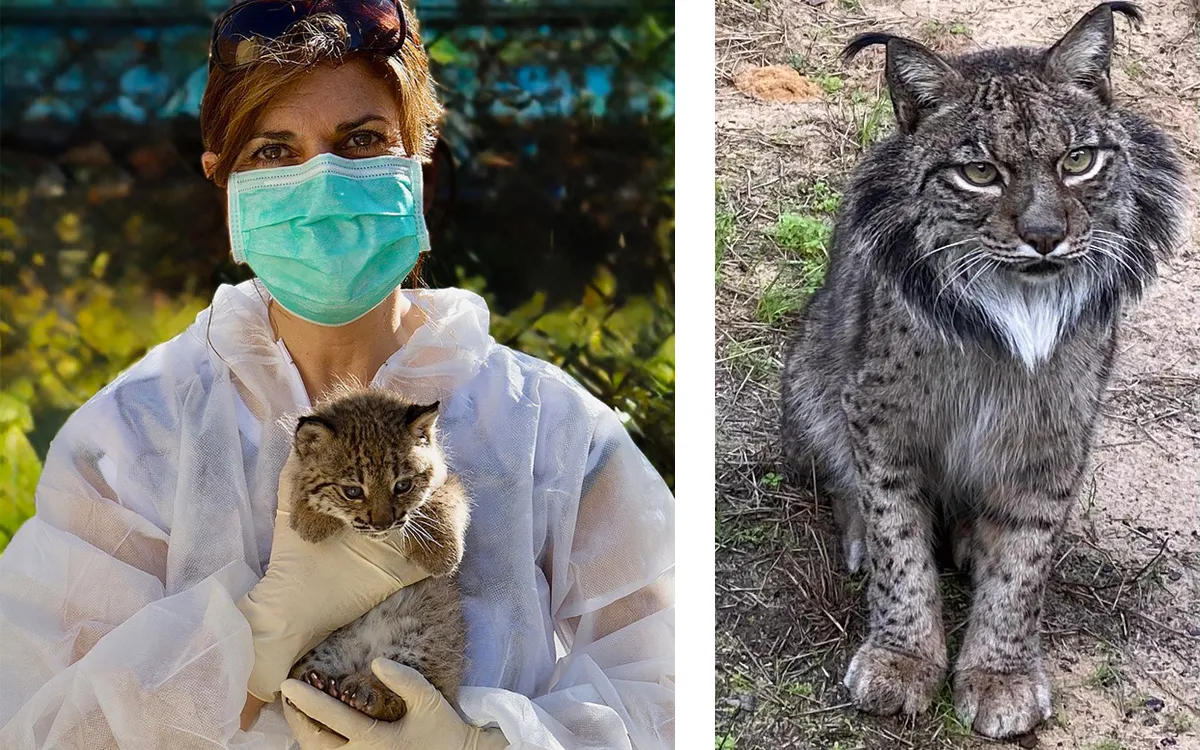
Astrid leading the recovery of the critically endangered Iberian lynx in Spain.
III. Species to Spaces: Enabling Leadership at the Landscape Scale
After nearly a decade laying the foundations for Iberian lynx recovery, Astrid shifted her focus from saving individual species to restoring whole ecosystems. The change marked not only a shift in scale, but a new phase of leadership—less about directing teams, and more about creating the conditions for others to step forward and lead.
She joined Commonland, a Dutch organisation pioneering large-scale restoration through its Four Returns model: return of inspiration, social capital, natural capital, and investment through nature-positive businesses. While all four resonated with her experience, it was the Return of Inspiration that struck most deeply. Years of working under intense ecological and political pressure had convinced Astrid that lasting change depends not only on science and funding, but on meaning, motivation, and a shared sense of possibility.
Commonland asked her to identify a degraded Spanish landscape where the model could be applied. After assessing 21 landscapes, the choice fell on AlVelAl—a vast, million-hectare high steppe in southeastern Spain. Despite lying between biodiversity hotspots and protected areas, AlVelAl had suffered decades of desertification, land degradation, and rural abandonment, representative of the challenges facing many Mediterranean landscapes.
Drawing on lessons from the Iberian lynx and black-footed ferret programmes, Astrid approached the work not as an expert delivering solutions, but as a facilitator of process. She focused on opening spaces for dialogue, trust-building, learning, co-creation, and celebration—encouraging farmers, landowners, and local entrepreneurs to take ownership of the transformation.
Under her guidance, local stakeholders founded the AlVelAl Association, fully run by farmers and entrepreneurs and comprising more than 500 members. She also supported the creation of the Alliance for Regenerative Education, promoting regenerative learning from early childhood through later life. Astrid did not act as a consultant, but as a committed team member—stepping into the front seat to help articulate and safeguard a common vision, then deliberately moving to the back seat to empower others to lead, listening deeply, bridging perspectives, and facilitating collective processes.
To further strengthen the Return of Inspiration, Astrid founded Inspiration 4 Action (see here), an initiative that she leads using creativity, art, and celebration to reconnect people with their capacity to drive change (see here). Its premise is simple yet powerful: by stepping outside everyday work contexts and engaging in collective creative action, people rediscover agency, confidence, and shared purpose. A central aim of the initiative is to empower women and young people toward conservation/restoration leadership.
One ongoing project, Regenerating Butterflies, is led by young influencers mentored by Astrid and aspires to become the world’s largest land-art initiative dedicated to raising awareness and support for pollinators—while bringing communities together through hands-on conservation action. The project is funded through the proceeds of Astrid’s book On a Butterfly’s Wing: Lessons from Nature on Embracing Change. It translates the book’s story into tangible impact by using its royalties to plant large, butterfly-shaped hedges of aromatic plants (each 10 m²), providing vital food and habitat for butterflies and other pollinators.
Today, the AlVelAl example has scaled to ten landscapes across Spain and Portugal, and Astrid is part of the Iberian Network of Regenerative Territories (see here), a growing alliance working to position the Iberian Peninsula as a European leader in landscape-scale restoration. One of her greatest joys is seeing the Iberian lynx roaming freely across many of these regenerative territories—including AlVelAl itself—where, just a decade ago, such a return would have seemed unimaginable. It feels like closing a conservation circle, she says.
Reflecting on leadership, Astrid notes that what matters most is rarely taught in schools. Years navigating extinction risk, political conflict, and personal transformation have shown her that thriving teams depend less on authority than on attention: listening deeply, choosing words with care, and understanding not only allies, but also critics and donors—their motivations and fears. She speaks of following one’s calling and encouraging others to do the same; of aligning head, heart, and hands (our thinking, with our feelings and our actions); of using joy as a compass and patience as a daily practice. Gratitude, celebration—of small steps as much as major milestones—and kindness, especially in moments of doubt, are essential leadership tools. Staying teachable, empowering women in decision-making roles, and cultivating the skills that allow others to lead have become central to her work. At this stage of her journey, leadership is less about standing at the front and more about holding space—so that people, communities, and ecosystems can lead their own way forward.
When asked about failures and regrets throughout her career, Astrid reflects that what she considers one of her greatest strengths—caring for people—has also been one of her greatest weaknesses. She once believed that everyone had a valid role to play, and that when someone was not performing, it simply meant they were in the wrong position. In retrospect, she recognises that this is not always the case: sometimes people are simply not up to the task at hand and, for the common good, it is important to remove them from a team. She recognises the crucial importance of putting systems in place to support a slow and deliberate hiring process, alongside a gentle but efficient approach to letting people go.

One of the regenerative “butterfly living sculptures” promoted by Astrid.
Leadership Lessons Drawn from Astrid’s Experience
Choose mentors who expand your courage, not your dependency
Early on Astrid learnt that good mentors don’t micromanage. They think long-term, protect emerging leaders when needed, and step back at the right moment.
Lead from inner clarity and cultivate resilience
What carries you through resistance is not status, but a grounded trust in your own judgement, backed by preparation and action.
Nurture quiet authority, not force
Quiet authority comes from competence, consistency, and trust. This form of leadership is less visible, but often more effective—especially in complex, multi-actor systems, and in the case of women, in male-dominated environments.
Develop your own facilitation toolbox
Basic facilitation skills help people move through confusion, disagreement, or inertia. As a leader, having your own facilitation toolbox will allow you to help your team to think clearly together, feel engaged, and keep moving without needing dominance.
Leadership is compatible with motherhood—but not without support
Astrid’s story challenges the myth of solitary leadership. Her ability to lead at the highest level depended on shared responsibility at home. Leadership does not require sacrificing family; finding support systems is key to sustaining good balance and long-term commitment.
Treat conflict as part of the landscape
Conservation is inherently political. Progress depends less on avoiding conflict than on staying present within it—listening carefully, negotiating patiently, and holding steady when tensions rise.
Know your team, know your donors, know your opponents
Effective leadership begins with understanding people—their motivations, values, fears, and hopes. Astrid’s experience shows that progress depends not only on technical expertise, but on taking the time to learn what drives those around you. Leadership, in this sense, is as much about listening and empathy as it is about vision and direction.
Design for collaboration instead of hoping for it
Consensus does not emerge organically in high-stakes conservation. Collaboration must be structured—through proximity, shared goals, and intentional relationship-building. Shape conditions where cooperation becomes possible.
Create cultures of pride and shared purpose
Conservation work thrives when people feel seen, valued, and part of something meaningful. Beyond plans and protocols, Astrid learned the importance of inspiration, celebration and shared identity in keeping teams and communities motivated through long, uncertain timelines.
The leader’s role changes with time
Early leadership required decisiveness and control. Later leadership demanded restraint and the ability to step back. Astrid learned to move between the front seat and the back seat as the context required. Mature leadership is adaptive, not fixed.
Kindness needs structure
Caring deeply about people is a strength—but without clear systems, it can quietly undermine a team. Moving slowly when hiring, being honest about performance, and acting early when someone is not the right fit are not acts of cruelty. They are acts of care—for the work, for the team, and ultimately for the people involved.
This text was prepared by Astrid Vargas and Ignacio Jiménez, based on Astrid’s presentations at the Effective Conservation training courses. You can see one of these presentations in our YouTube channel (see here)
Links to Resources for Further Exploration
Websites:
Inspiration 4 Action (Astrid’s website about collective creativity for people and nature)
Head, Hearts and Hands (The story of Alvelal – an Intermedia Productions documentary directed by Astrid about the use of regenerative agriculture as a tool for landscape restoration)
Regenerating Butterflies (aspiring to be the largest landart project that supports butterflies and other pollinators, led by young, regenerative influencers)
The Iberian Network of Regenerative Territories (positioning Spain and Portugal as European leaders in landscape restoration)
Books:
Iberian Lynx Ex-situ Conservation. An Interdisciplinary Approach. Pillars of captive breeding for reintroduction programs, based on the Iberian lynx example.
On a Butterfly’s Wing. Lessons from Nature on Embracing Change. A true story that blends science, philosophy, art and conservation, told from the perspective of a disabled butterfly.
